
Four chats to find one answer.
You open every agent's window in turn to work out where the thing has stopped. By the fourth you have forgotten what the first one said, and none of them knows what the others are doing.
Output 02 · Built in our factory
Being built right now — by the crew it will manage.
Several AI agents on one project is not four times the output. It is four times the places where the answer might be. KrAIken is the manager: who is working on what, and where your hand is needed.
On the production line
ReleAIse the KrAIken
Why it exists
We did not start from a market gap. We started from two things that were wasting a working day a week.
You open every agent's window in turn to work out where the thing has stopped. By the fourth you have forgotten what the first one said, and none of them knows what the others are doing.
Once to each agent. By the fourth telling you have changed the wording, and now there are two versions of a decision nobody wrote down.
KrAIken is what we built instead.
What it does
It sits in front of every write. It can refuse one — which is the part that makes a crew of agents safe to leave running.
Every agent, what it is on, and what state it is in. One place, one answer, no tab-switching to assemble it.
A list of the things only a person can move — separated from everything else, so the urgent colour is never spent on work that is not your turn.
Numbered, dated, never edited afterwards. An agent that joins on day three reads the log and is caught up. So can you.
A stale document, a malformed message, an approval an agent is not entitled to give. Two agents cannot quietly overwrite each other's work.
How it is put together
The words are not decoration — they are the schema, the screens and the log. We use the same three everywhere so nothing has two names.
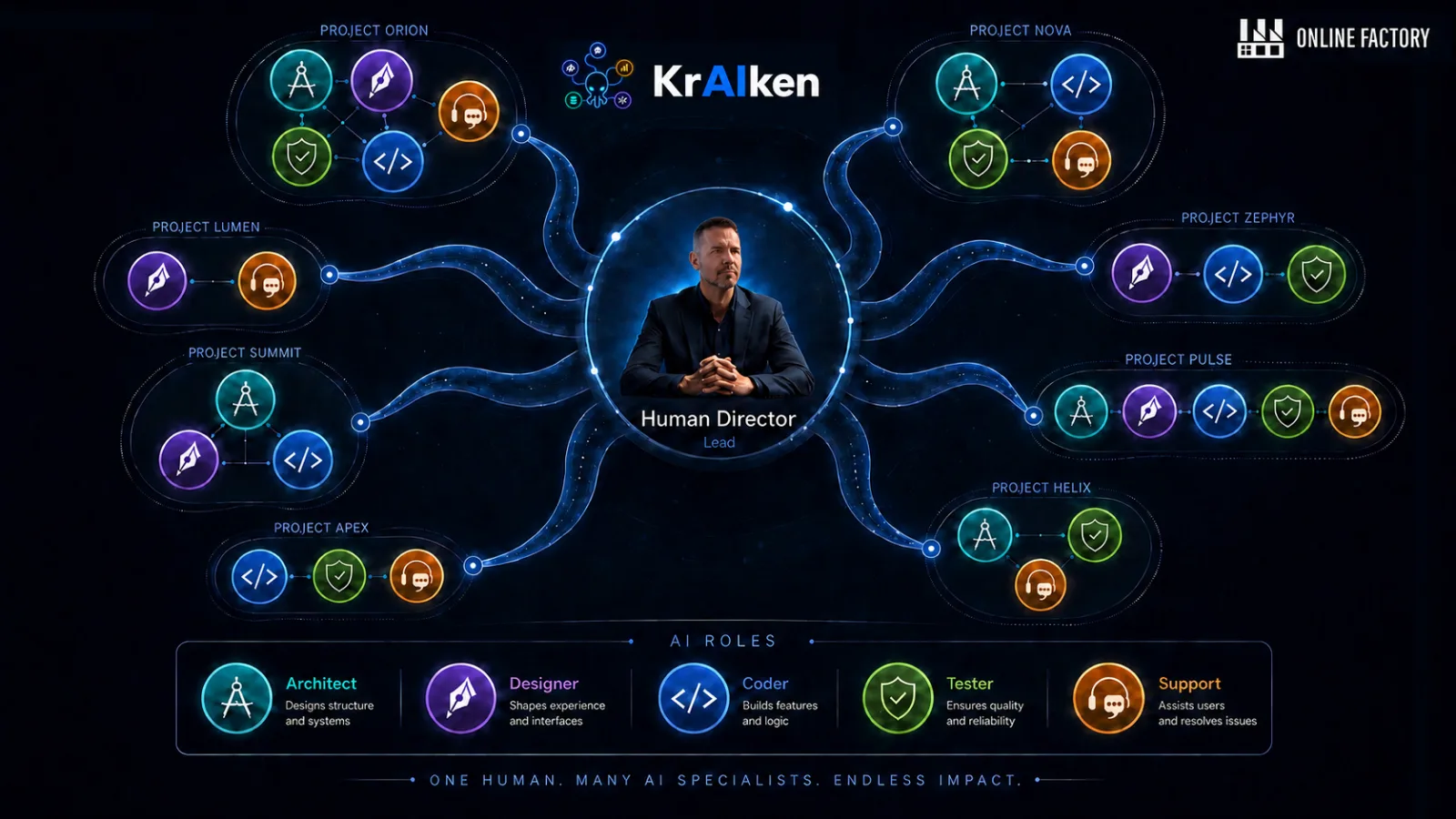
The control window
The interface exists and the crew is testing it this week. We would rather show you nothing than show you a render of software that does not run yet — which is, more or less, the whole point of this page.
Tell me when it is up →Build log
Updated when something is true, not on a schedule. If a week is quiet, the log is quiet.
In internal testing now. Target for the first public release: Q1 2027. If it slips, this line will say so.
Leave an address and you will hear when it is — one mail, from a person, no list. If you are running agents in parallel already, tell us where it hurts; that is what the next version gets built against.